
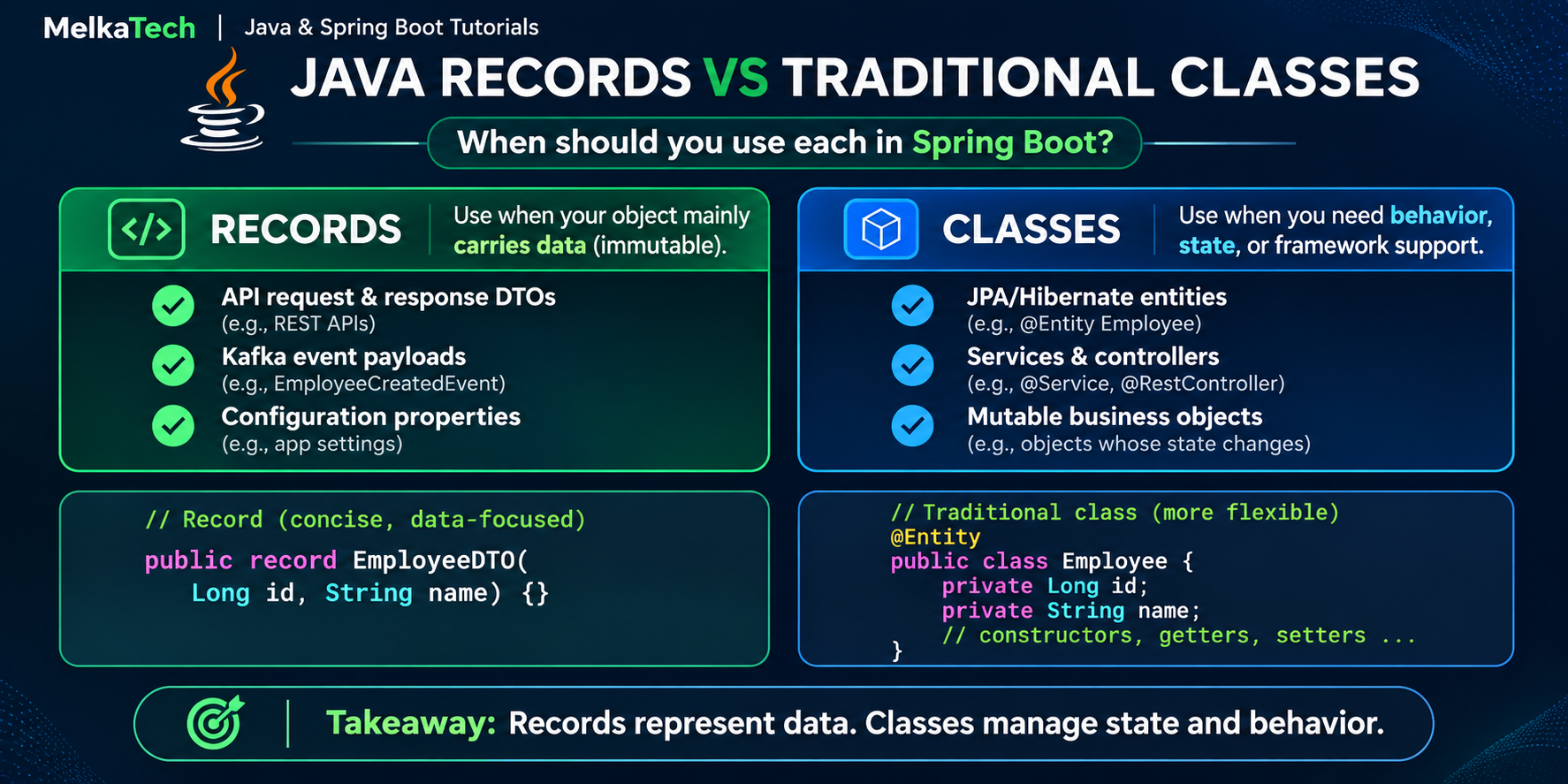
Should We Use Java Records Everywhere in Spring Boot?
The answer is NO!
Java Records are one of the useful features of modern Java. They help us write cleaner, shorter, and more readable code by eliminating repetitive boilerplate.
But here's something every Java developer should understand:
Not every Java class should be replaced with a Record.
Let's understand when to use Records, when to use traditional Classes, and why this matters in real Spring Boot applications.
1. First, What Is a Java Record?
Imagine you're developing an Employee Management System.
You need an object to transfer employee information between your Spring Boot backend and frontend.
Traditionally, you might write:
public class EmployeeResponse {
    private Long id;
    private String name;

    public EmployeeResponse(Long id, String name) {
        this.id = id;
        this.name = name;
    }

    public Long getId() {
        return id;
    }

    public String getName() {
        return name;
    }

    // equals(), hashCode(), toString()
}
That's a lot of code just to represent two fields!
Now look at the same example using a Java Record:
public record EmployeeResponse(
    Long id,
    String name
) {}
That's it!
Java automatically generates:
#Constructor
#Accessor methods (id(), name())
equals()
#hashCode()
toString()
Less boilerplate. Same data representation. Cleaner code.
2. When Should We Use Records?
Records are a great choice when an object's primary responsibility is to carry data rather than manage changing state.
In Spring Boot, common use cases include:
** REST API Request DTOs**
When a frontend sends data to your backend:
public record CreateEmployeeRequest(
    String name,
    String email
) {}
The request object carries the submitted values to your application.
REST API Response DTOs
When your backend returns employee information:
public record EmployeeResponse(
    Long id,
    String name,
    String email
) {}
Records work well here because the response represents a fixed set of values.
Kafka Event Payloads
In microservices, we often publish events containing information about something that happened.
public record EmployeeCreatedEvent(
    Long employeeId,
    String employeeName,
    String eventType
) {}
Records make these event payloads concise and easy to understand.
Spring Boot Configuration Properties
Records can also represent configuration values loaded through Spring Boot's configuration binding.
@ConfigurationProperties(prefix = "app")
public record AppConfig(
    String name,
    String version
) {}
This works with appropriate configuration-properties registration.
3. When Should We NOT Use Records?
This is where understanding the difference becomes important.
JPA/Hibernate Entities
Consider an employee stored in a database.
@Entity
public class Employee {

    @Id
    @GeneratedValue
    private Long id;

    private String name;
    private String email;

    protected Employee() {}

    // Constructors, getters, setters
}
Why use a Class instead of a Record?
Because standard JPA entities have requirements involving their lifecycle, identity, constructors, and non-final classes.
Records are final, and their component fields cannot be reassigned after construction.
For example, an employee's email may change, and Hibernate can track that change on a managed entity.
Use traditional Classes for standard JPA entities.
**Spring Boot Services ** Services are responsible for business operations, validation, and coordination between components.
@Service
public class EmployeeService {

    private final EmployeeRepository repository;

    public EmployeeService(
            EmployeeRepository repository) {
        this.repository = repository;
    }

    public Employee findById(Long id) {
        return repository.findById(id)
            .orElseThrow();
    }
}
Although records can contain methods, traditional classes are the conventional and clearer choice for Spring services.
REST Controllers
Controllers handle HTTP requests, call services, and return responses.
They represent application behavior rather than simple data.
A traditional Class is generally the better choice.
** Objects Requiring Mutable State**
Suppose an employee's department changes from IT to Finance.
With a traditional mutable class, we can update the object's state:
employee.setDepartment("Finance");But with a Record, we cannot reassign its component fields:
employee.department = "Finance"; // Instead, we must create a new record containing the updated value.
4. Real-World Spring Boot Architecture
Let's connect everything in one practical example.
Imagine a frontend sends a request to create an employee.
Step 1: Frontend sends employee data
{
  "name": "Simon",
  "email": "simon@example.com"
}
Step 2: Controller receives the Request Record
public record EmployeeRequest(
    String name,
    String email
) {}
Step 3: Service processes the request
@Service
public class EmployeeService {
    // Business logic
    // Validation
    // Database operations
}
Step 4: JPA Entity represents the database record
@Entity
public class Employee {
    @Id
    private Long id;

    private String name;
    private String email;

    protected Employee() {}

    // Constructors and accessors
}
Step 5: Backend returns a Response Record
public record EmployeeResponse(
    Long id,
    String name,
    String email
) {}
The overall flow looks like this:
Frontend ? Request Record ? Controller Class ? Service Class ? JPA Entity Class ? Database
And when returning the result:
Database ? Service Class ? Response Record ? Frontend
Notice something important?
We use Records and Classes together, each for the responsibility it handles best.
5. Java 17 vs Java 21
Both Java 17 and Java 21 fully support Records.
Records became a permanent Java feature in Java 16.
However, Java 21 finalized Record Patterns, making it easier to extract data from records during pattern matching.
For example:
record Employee(Long id, String name) {}

Object obj = new Employee(1L, "Simon");

// Java 21
if (obj instanceof Employee(Long id, String name)) {
    System.out.println(name);
}
This allows us to extract record components directly without manually calling their accessor methods.
Final Takeaway
Use Java Records when:
Your object primarily carries data.
You want concise, readable DTOs.
You don't need to reassign its component fields.
Use Traditional Classes when:
You need mutable state.
You're implementing standard JPA entities.
You're writing services, controllers, or behavior-rich objects.
You need class inheritance.
Remember this simple rule:
Records ? Represent data.
Classes ? Manage state and behavior.
Records are not designed to replace every Java class.
They are designed to make data-oriented code simpler and more expressive.
Good software engineering isn't about using the newest feature everywhere. It's about choosing the right feature for the right responsibility.
? What's your approach? Are you using Java Records for DTOs in your Spring Boot microservices, or do you still prefer traditional Classes?
Let's discuss in the comments!
Join the discussion
Ask a question or share what you learned. Comments are reviewed before appearing.