
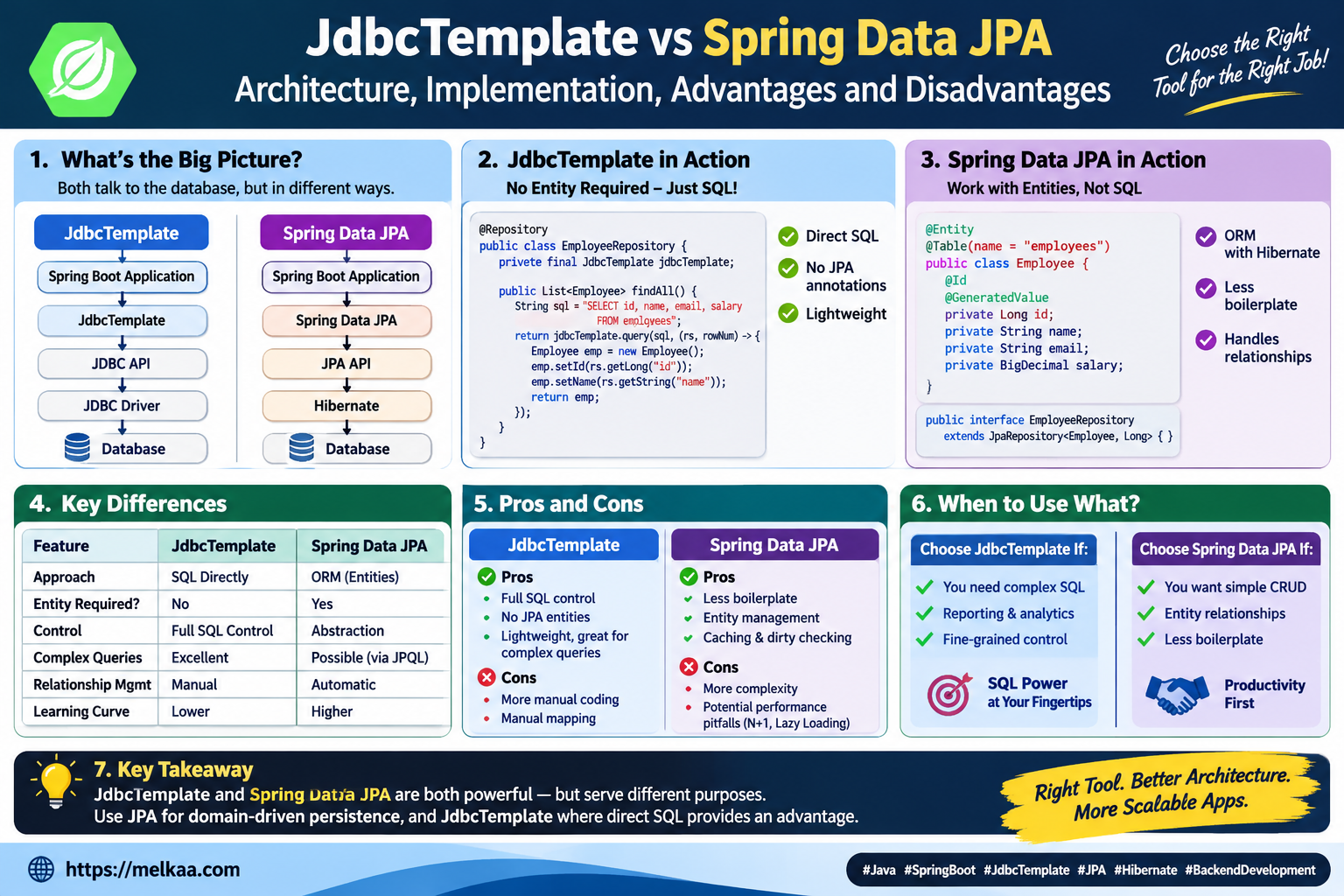
JdbcTemplate vs Spring Data JPA: Architecture, Implementation, Advantages and Disadvantages
When developing enterprise Java applications with Spring Boot, choosing the right database access technology is an important architectural decision.
Two commonly used approaches are Spring JdbcTemplate and Spring Data JPA.
Although both technologies interact with relational databases such as PostgreSQL and MySQL, they follow different approaches to database operations.
In this article, we will explore how they work, their architectural differences, practical implementations, advantages, disadvantages, and when to use each in real-world applications.
1. Understanding JDBC, JdbcTemplate, JPA, and Hibernate
Before comparing JdbcTemplate and JPA, let's understand how these technologies relate to each other.
1.1 JDBC (Java Database Connectivity)
JDBC is the standard Java API that allows Java applications to communicate with relational databases.
It provides important interfaces such as:
Connection– Establishes a connection to the database.PreparedStatement– Executes parameterized SQL statements.ResultSet– Holds the results returned by database queries.
When using JDBC directly, developers must manually manage database connections, execute SQL queries, process results, handle exceptions, and release resources.
1.2 JdbcTemplate
JdbcTemplate is a Spring Framework abstraction built on top of JDBC.
It simplifies database operations by handling:
- Database connection management.
- SQL statement execution.
- ResultSet processing.
- Exception translation.
- Resource cleanup.
You still write SQL queries yourself, but Spring handles much of the JDBC boilerplate code.
1.3 JPA (Java Persistence API)
JPA is a Java specification that defines how Java objects are mapped to relational database tables.
It allows developers to work with Java entities instead of manually writing SQL for every database operation.
JPA provides standards for:
- Entity mapping.
- Database relationships.
- Persistence operations.
- Query execution.
- Transaction management.
1.4 Hibernate
Hibernate is one of the most popular implementations of the JPA specification.
Spring Data JPA provides an additional repository abstraction that makes working with JPA even easier.
Important: Both JdbcTemplate and Hibernate ultimately communicate with relational databases through JDBC.
The main difference is the abstraction layer and persistence management provided by each approach.
2. Architectural Differences
Although both technologies communicate with the same database, their execution paths are different.
JdbcTemplate Architecture
Spring Boot Application
         |
         v
    JdbcTemplate
         |
         v
       JDBC API
         |
         v
     JDBC Driver
         |
         v
      Database
Spring Data JPA Architecture
Spring Boot Application
         |
         v
   Spring Data JPA
         |
         v
       JPA API
         |
         v
      Hibernate
         |
         v
     JDBC Driver
         |
         v
      Database
Key difference:
JdbcTemplate executes SQL directly through JDBC, while JPA uses an ORM (Object-Relational Mapping) framework to manage entity persistence.
3. How JdbcTemplate Works Without an Entity
One interesting feature of JdbcTemplate is that it does not require JPA entity classes.
Let's understand why through a practical example.
Suppose we have the following PostgreSQL table:
Database Table
CREATE TABLE employees (
    id BIGSERIAL PRIMARY KEY,
    name VARCHAR(100),
    email VARCHAR(150),
    salary DECIMAL(12,2)
);
With JdbcTemplate, we can map database records into ordinary Java objects.
Step 1: Create a Java POJO
public class Employee {

    private Long id;
    private String name;
    private String email;
    private BigDecimal salary;

    // Getters and setters
}
Notice that we don't need the following JPA annotations:
@Entity@Table@Id@Column
Why?
Because JdbcTemplate does not depend on ORM metadata. It works directly with SQL queries and JDBC ResultSets.
The Employee class is simply a Java object used to hold the data returned from the database.
Step 2: Create a Repository Using JdbcTemplate
@Repository
public class EmployeeRepository {

    private final JdbcTemplate jdbcTemplate;

    public EmployeeRepository(JdbcTemplate jdbcTemplate) {
        this.jdbcTemplate = jdbcTemplate;
    }

    public List<Employee> findAll() {

        String sql = """
            SELECT id, name, email, salary
            FROM employees
            """;

        return jdbcTemplate.query(sql, (rs, rowNum) -> {

            Employee employee = new Employee();

            employee.setId(rs.getLong("id"));
            employee.setName(rs.getString("name"));
            employee.setEmail(rs.getString("email"));
            employee.setSalary(rs.getBigDecimal("salary"));

            return employee;
        });
    }
}
Understanding RowMapper
The following code is particularly important:
jdbcTemplate.query(sql, (rs, rowNum) -> {Here:
query()executes the SQL statement.rsrepresents the JDBC ResultSet.rowNumrepresents the current row number.- We manually convert each database row into an Employee object.
This mapping mechanism is called RowMapper.
It allows us to control exactly how database records are converted into Java objects.
Step 3: Insert an Employee
public int save(Employee employee) {

    String sql = """
        INSERT INTO employees(name, email, salary)
        VALUES (?, ?, ?)
        """;

    return jdbcTemplate.update(
        sql,
        employee.getName(),
        employee.getEmail(),
        employee.getSalary()
    );
}
Here:
?represents a parameter placeholder.update()executes INSERT, UPDATE, or DELETE statements.- The method returns the number of affected rows.
JdbcTemplate uses parameterized prepared statements for these operations, helping protect against SQL injection when values are passed as parameters.
Step 4: Find an Employee by ID
public Employee findById(Long id) {

    String sql = """
        SELECT id, name, email, salary
        FROM employees
        WHERE id = ?
        """;

    return jdbcTemplate.queryForObject(
        sql,
        (rs, rowNum) -> {

            Employee employee = new Employee();

            employee.setId(rs.getLong("id"));
            employee.setName(rs.getString("name"));
            employee.setEmail(rs.getString("email"));
            employee.setSalary(rs.getBigDecimal("salary"));

            return employee;
        },
        id
    );
}
Note: queryForObject() expects one result. If no matching record exists, it throws an EmptyResultDataAccessException.
As you can see, JdbcTemplate allows us to interact directly with the database without requiring JPA entities or Hibernate.
4. How the Same Operation Works with JPA
Now let's implement the same functionality using Spring Data JPA.
Step 1: Create an Entity
@Entity
@Table(name = "employees")
public class Employee {

    @Id
    @GeneratedValue(strategy = GenerationType.IDENTITY)
    private Long id;

    private String name;

    private String email;

    private BigDecimal salary;

    // Getters and setters
}
Here, Hibernate understands how the Java class maps to the database table.
Important JPA Annotations
| Annotation | Purpose |
|---|---|
@Entity | Marks a class as a persistent entity |
@Table | Specifies the database table |
@Id | Identifies the primary key |
@GeneratedValue | Configures primary-key generation |
@Column | Configures column mapping |
Step 2: Create a JPA Repository
@Repository
public interface EmployeeRepository
        extends JpaRepository<Employee, Long> {

    Optional<Employee> findByEmail(String email);
}
Spring Data JPA provides common CRUD operations automatically.
For example:
save()findById()findAll()deleteById()existsById()
Step 3: Save an Employee
@Service
public class EmployeeService {

    private final EmployeeRepository repository;

    public EmployeeService(EmployeeRepository repository) {
        this.repository = repository;
    }

    public Employee save(Employee employee) {
        return repository.save(employee);
    }
}
Hibernate generates the necessary SQL and executes it through JDBC.
Unlike JdbcTemplate, JPA manages entity persistence, relationships, and changes to managed entities through its persistence context.
5. Advantages and Disadvantages
Understanding the strengths and limitations of both approaches helps us make better architectural decisions.
JdbcTemplate
Advantages
- Full control over SQL queries.
- Does not require JPA entity classes.
- Lightweight persistence approach.
- Excellent for complex joins and reporting.
- Easier to optimize specific SQL statements.
- Avoids Hibernate persistence-context overhead.
Disadvantages
- Requires more manual SQL writing.
- Database result mapping must be handled manually.
- Relationship management is manual.
- No automatic dirty checking.
- No automatic ORM-level entity caching.
- More maintenance when database structures change.
Spring Data JPA
Advantages
- Less boilerplate code.
- Automatic entity mapping.
- Simplified CRUD operations.
- Supports entity relationships.
- Automatic dirty checking.
- Supports persistence contexts and caching.
Disadvantages
- Hibernate configuration can become complex.
- Lazy loading can cause unexpected queries.
- N+1 query problems can affect performance.
- Generated SQL might not always be optimal.
- Persistence contexts consume memory.
- Requires understanding ORM behavior.
6. Final Thoughts
JdbcTemplate and Spring Data JPA are both powerful database access technologies in Spring Boot, but they serve different purposes.
JdbcTemplate provides direct SQL control and is particularly useful for complex queries, reporting, and SQL-intensive operations.
Spring Data JPA simplifies application development through ORM, entity mapping, repository abstractions, and relationship management.
My recommendation: Don't replace JPA everywhere just because JdbcTemplate gives you more SQL control. Use JPA for domain-oriented persistence and JdbcTemplate where direct SQL provides a clear advantage.
Choosing the right tool for the right database operation is what makes an enterprise Spring Boot application maintainable, efficient, and scalable.
Join the discussion
Ask a question or share what you learned. Comments are reviewed before appearing.